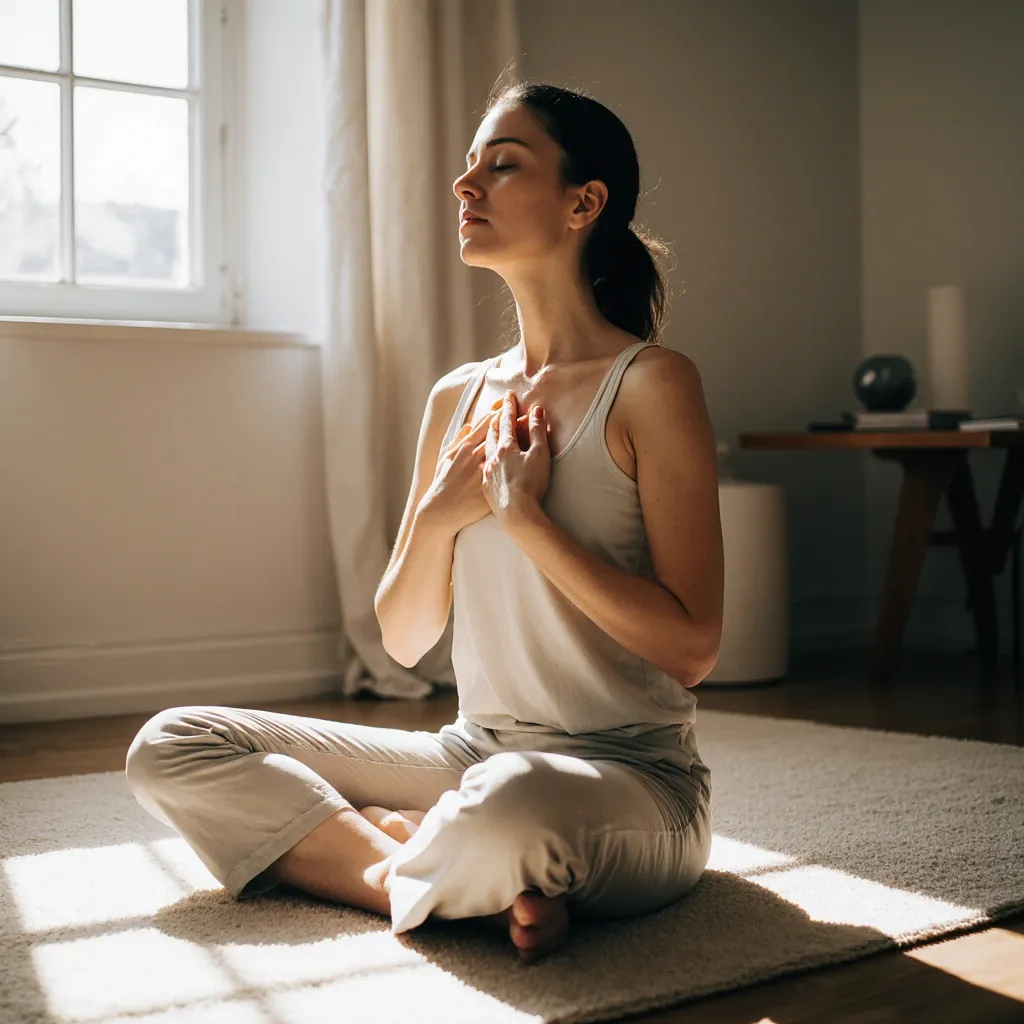
Your Body Won’t Calm Down? 6 Somatic Exercises That Actually Work
amine
16 min read
Your legs won’t stop shaking. Your chest is tight. Your breath keeps getting stuck. And your body won’t calm down — even when nothing is actually wrong, even when you know you’re safe, even when you’ve told yourself to relax a hundred times.
This is not anxiety in your mind. This is your nervous system stuck in survival mode.
That distinction matters more than anything else in this guide. Because a mind problem gets solved with thinking. A nervous system stuck in survival mode gets solved with something completely different — body-based signals that speak directly to the part of you that is still braced for danger.
That’s what somatic exercises are. Not reframing. Not breathing tricks. Direct physiological inputs that tell your nervous system, at a body level: the threat is over. You can come down now.
This is not a substitute for professional mental health care. If you are experiencing significant trauma symptoms or a mental health crisis, please consult a licensed therapist.
⚡ Do This Right Now — 30-Second Reset
Before you read another word, do this. Thirty seconds. It will show you — not tell you — what somatic work actually is.
Try this now — eyes open, wherever you are:
Look around the room slowly. Let your eyes land on one object. Notice its colour. Its shape. Its distance from you.
Feel your feet on the floor. Press them down gently. Notice the pressure.
Take one slow breath in through your nose. Then exhale through your mouth — make the exhale twice as long as the inhale.
If your body softened even slightly — a breath that came easier, a shoulder that dropped, one moment of less — that is your nervous system responding to a safety signal. That is somatic work. Everything in this guide builds on that exact mechanism.
Why Your Body Is Still Holding It
Most anxiety advice is cognitive. Change your thoughts. Reframe the situation. Challenge the narrative. And it can help — for the part of your brain that processes language and logic.
But when you’re anxious, that part of your brain is not in charge. Your nervous system is. And your nervous system evolved hundreds of millions of years before language. It doesn’t understand words. It doesn’t respond to reassurance. It responds to physical signals — breath, movement, muscle tone, eye position, the pressure of your feet on the ground.
When you’re stuck in fight-or-flight, your body is running a survival program. That program cannot be reasoned with. It can only be completed — through the same body-based language that started it.
This is why somatic exercises work when everything else hasn’t. They’re not overriding your nervous system. They’re speaking its actual language.
The core principle — remember this throughout: “Your nervous system responds to sensation, not logic. Your body learns safety through repetition — not through thinking.” This is not a metaphor. It is the mechanism. Come back to it whenever the practice feels like it isn’t working.
6 Somatic Exercises for Beginners
These six practices are sequenced intentionally. Start with Practice 1 and spend two to three days with it before adding the next. Nothing here should feel forced. Go at your own pace. Your body doesn’t need intensity — it needs consistency.
Exercise
Best For
Time
Difficulty
1. Body Inventory
Reconnecting to your body
5–10 min
Easy
2. Orienting
Discharging the threat loop
3–5 min
Easy
3. Somatic Grounding
Anxiety spikes, dissociation
3–5 min
Easy
4. Physiological Sigh
Fast reset, panic, stress spikes
2–3 min
Easy
5. Pendulation
Building distress tolerance
5–10 min
Intermediate
6. Neurogenic Tremoring
Deep stored stress discharge
10–15 min
Intermediate
Practice 1: Body Inventory (The Foundation)
✔ Best for: feeling numb, disconnected, or chronically overwhelmed · ✔ Time: 5–10 min · ✔ Difficulty: Easy
What it is: A slow, non-judgmental scan of your body from head to feet — noticing whatever is present without trying to change it.
Why it works in your body: Chronic stress causes a gradual loss of body awareness — scientists call it interoceptive blunting. Your nervous system learns to suppress sensation because feeling the body during prolonged threat became overwhelming. The body inventory gently rebuilds your ability to sense your own internal state. You cannot regulate what you cannot feel. This is the foundation everything else stands on.
Sit or lie down comfortably. Close your eyes if that feels safe, or soften your gaze toward the floor.
Begin at the top of your head. Without trying to change anything, simply notice: tension? Warmth? Pressure? Numbness? Tingling?
At each area, pause for 3–5 breaths. Just gather information. You are not fixing anything. You are learning to listen.
At the end, take one full slow exhale and open your eyes.
What you might feel: Very little at first — completely normal. Some people feel unexpected emotion arise in certain areas. If that happens, don’t push through it. Just notice it and move on. You’re not doing anything wrong.
Most common mistake: Trying to relax the tension you find. Your only job is to notice it. Relaxation is a side effect — not something you manufacture.
Why this works: The simple act of noticing body sensation without judgment begins to shift the state of your autonomic nervous system — before you’ve “done” anything at all.
The body inventory often surfaces things you didn’t realise you were carrying — and processing what comes up alone can feel like too much. The Somatic Calm Journal includes 90 days of guided body-awareness prompts designed to help you track and work through what emerges, one small step at a time. → Explore the Somatic Calm Journal
Practice 2: Orienting (The Safety Signal)
✔ Best for: anxiety that won’t settle, racing thoughts, hypervigilance · ✔ Time: 3–5 min · ✔ Difficulty: Easy
Orienting: soft, slow gaze movement that signals safety directly to your brain stem — not your thinking mind.
What it is: A slow, intentional look around your environment that directly communicates safety to your threat-detection system — through your eyes.
Why it works in your body: Your nervous system runs its threat assessment largely through your eyes. When you’re anxious, your gaze narrows and speeds up — scanning urgently. That rapid scanning itself signals threat to your brain stem. By deliberately slowing your gaze and letting it rest on neutral objects, you send the opposite signal: “I am looking around and finding it safe.” Watch any mammal after a stressor — it shakes, then looks around slowly, then settles. You are doing that “look around” phase consciously.
Sit comfortably. Let your eyes be soft — not searching urgently for anything.
Let your gaze move around the room slowly. Let it land somewhere neutral or pleasant.
When it lands, pause there. Notice the colour, texture, shape, distance. Take 2–3 slow breaths.
Continue for 3–5 minutes at your own pace. There is nowhere to get to.
Notice: is there any settling in your body? An involuntary exhale? A slight softening somewhere?
What you might feel: A spontaneous, involuntary sigh — your nervous system releasing held breath. A loosening in the jaw or shoulders you didn’t consciously create. That’s not you relaxing. That’s your body responding to the signal you sent it.
Most common mistake: Moving your eyes too fast. Go so slowly it almost feels strange. If this feels uncomfortable, slow down further. That discomfort is information — not failure.
Continue Reading
Part 2 of 3 — Going Deeper
You're off to a great start. The next section explores the practical steps and the science that makes this work.
Total read time: 16 min
Part 2 of 3
Practice 3: Somatic Grounding (Coming Back to Now)
✔ Best for: feeling spacey, dissociated, stuck in thought loops · ✔ Time: 3–5 min · ✔ Difficulty: Easy
The floor is always here, always present — one of the fastest ways to pull your nervous system back from future threat into present safety.
What it is: Using physical contact — your feet on the floor, your back against a chair, your hands on your thighs — to anchor your awareness in the present moment through undeniable body sensation.
Why it works in your body: Anxiety exists in time — in past regrets and future fears. Your body exists only right now. When you deliberately feel physical pressure and weight, you activate proprioceptive pathways that pull your nervous system into the present moment, interrupting the threat simulation running in your prefrontal cortex.
Sit in a chair with both feet flat on the floor. Feel the weight of your body pressing down through your feet.
Press your feet gently but firmly into the floor. Notice the pressure. Notice the texture.
Press your back into the chair. Feel the support. Let the chair hold you — you don’t need to hold yourself.
Place your hands palm-down on your thighs. Feel the warmth, the weight, the contact.
Take three slow breaths, feeling your feet, back, and hands simultaneously.
Say quietly — internally or aloud: “I am here. I am in this room. I am safe right now.”
What you might feel: A heaviness in your legs and feet — a good sign. A sense of being more “landed.” Go at your own pace. Nothing here should feel rushed.
Most common mistake: Moving through it quickly. Each point of contact deserves 30–60 seconds of actual attention. The settling happens gradually.
✔ Best for: acute anxiety, panic onset, stress spikes · ✔ Time: 2–3 min · ✔ Difficulty: Easy
Two inhales through the nose, one long exhale through the mouth — the fastest known method to lower heart rate and reduce acute anxiety.
What it is: A two-part inhale followed by a long, slow exhale — the fastest known method for reducing physiological arousal in real time.
Why it works in your body: During stress, tiny air sacs in your lungs (alveoli) partially collapse, amplifying breathlessness and panic. The double inhale re-inflates them. The extended exhale then activates the vagus nerve — directly controlling your parasympathetic “rest and recover” response. Stanford’s Huberman Lab (Balban et al., 2023, Cell Reports Medicine) confirmed this outperforms every other breathing technique for real-time anxiety reduction.
Inhale through your nose — a normal-sized breath.
At the top of that inhale, take a second short sniff through the nose. This re-inflates the collapsed air sacs.
Exhale slowly and completely through your mouth — take at least twice as long as the combined inhale.
Let the body breathe naturally for 2–3 cycles.
Repeat 3–5 times.
What you might feel: An almost immediate drop in heart rate. Warmth spreading through your chest. Shoulders dropping without you deciding to drop them.
Most common mistake: Cutting the exhale short. The exhale is the entire mechanism. Don’t rush it.
Breathwork becomes significantly more effective in a structured sequence. The Breathwork Guide includes 7 targeted practices and a 5-minute Emergency Calm sequence you can use anywhere. → Explore the Breathwork Guide
Practice 5: Pendulation (Building Capacity)
✔ Best for: building distress tolerance, stuck emotional states · ✔ Time: 5–10 min · ✔ Difficulty: Intermediate — after one week of Practices 1–4
What it is: Moving your attention back and forth — like a pendulum — between a place in your body that feels tense or uncomfortable, and a place that feels neutral or comfortable.
Why it works in your body: Peter Levine developed pendulation as a core Somatic Experiencing tool because people with anxiety often can’t tolerate staying with difficult body sensations — the experience floods them. By deliberately moving to a “resource” place before flooding occurs, you teach your nervous system that discomfort is survivable and temporary. Over weeks, your window of tolerance expands. This is not avoidance — this is titration. The actual clinical method.
Close your eyes. Find a place in your body that feels tight, uncomfortable, or anxious. Note its quality — sharp, dull, pressing, twisting.
Now find a place that feels neutral, calm, or even slightly comfortable. Your feet, your hands. Take real time to locate this.
Spend 20–30 seconds at the comfortable place. Just breathe there.
Gently move attention back to the uncomfortable place. Notice: has anything changed?
Return to the comfortable place. Stay for 30 seconds.
Repeat 3–5 times. If your body resists, that’s information — not failure.
Most common mistake: Using this during acute crisis. Pendulation is capacity-building — it needs you regulated enough to move between sensations, not flooded by them.
Practice 6: Neurogenic Tremoring (The Deep Discharge)
✔ Best for: deep accumulated stress, chronic tension, held trauma patterns · ✔ Time: 10–15 min · ✔ Difficulty: Intermediate — 2–3× per week max
What it is: Allowing the body to tremor or shake — the natural biological mechanism all mammals use to discharge stored stress after threat has passed.
Why it works in your body: Every stressful event mobilises your nervous system — flooding your body with adrenaline, bracing your muscles. When that activation energy is never discharged, it accumulates as chronic tension, hypervigilance, and anxiety without obvious cause. Research on TRE (Berceli et al., Psychological Trauma, 2012) shows significant reductions in PTSD symptoms, anxiety, and chronic tension. Shaking is not a loss of control. It is your body doing exactly what it evolved to do.
Stand and do 10 slow calf raises to slightly fatigue your legs.
Sit on the floor with your back against a wall, knees bent, feet flat, heels close to your body.
Slowly let your knees fall open, then bring them back together. Repeat 10 times.
Allow your knees to fall open and hold. Notice if trembling begins in your legs or hips.
If it does, allow it completely. Breathe slowly. Let it continue for 5–10 minutes.
To stop: press your knees together, stretch your legs flat, breathe slowly for 5 full minutes. Do not skip this — it is where the nervous system consolidates the discharge.
Most common mistake: Stopping the tremor because it feels strange. The shaking is the point. Trust your body — it has been trying to do this for years. You’re finally letting it.
Doing too much too soon. Two practices per day is enough in the first two weeks. Consistency beats intensity — always.
Almost There
Part 3 of 3 — The Final Section
One last part — wrapping everything up with your action plan and answers to the most common questions.
You're 66% through the full article
Part 3 of 3
Evaluating instead of experiencing. The moment you shift from “I notice tightness in my chest” to “is this working?” — you’ve left somatic practice. Gently return to sensation. You are not performing. You are noticing.
Practicing only during crisis. Five minutes daily produces more lasting change than an hour once a week.
Waiting for a breakthrough. This work produces small, accumulating shifts — not dramatic ones. Small shifts are enough. They always have been.
When Somatic Exercises Don’t Work
If the exercises feel like they’re doing nothing: check whether you’re actually feeling body sensation or thinking about it. Practice 1 is specifically designed to rebuild this capacity. Give it two full weeks before drawing conclusions.
If the exercises feel like too much — overwhelming, destabilising, generating more anxiety: your nervous system is communicating that it needs more support than solo practice can provide. Working with a trained somatic therapist can make a significant difference.
You don’t need to fix everything today. If your body resists, that’s information — not failure. Ease up. Do less. Come back tomorrow.
Your 7-Day Beginner Roadmap
Day
Practice
Time
When to Do It
Day 1–2
Body Inventory
5 min
Same time each day — morning or evening
Day 3–4
Body Inventory + Orienting
8 min
Morning + whenever stress rises
Day 5
Add Physiological Sigh
10 min
Before each meal as a daily ritual
Day 6–7
Add Somatic Grounding
12 min
On waking + before sleep
Week 2
Add Pendulation
15 min
Once daily, dedicated session
Week 3
Add Neurogenic Tremoring
20 min
2–3 times per week — never back-to-back
Save this roadmap. Screenshot it. Write it out. Pin it where you’ll see it each morning. The knowing is easy. The daily returning — that is the practice.
For beginners who want a daily structure
Want a complete day-by-day system built around where you are right now?
The 30-Day Somatic Reset is a progressive nervous system retraining program — 15 minutes per day, combining all six exercises in a sequence designed to produce real, measurable change.
Designed for complete beginners. No prior experience needed.
Building a Practice That Lasts
Our morning nervous system reset routine is a 10-minute sequence combining orienting, physiological sighs, and grounding — designed for beginners, requiring no preparation, and working even on the days when you have the least to give.
A 5-minute practice done every day outperforms a 45-minute session done once a week. Your body learns safety through repetition — not through effort. Through showing up, again and again, with patience.
Frequently Asked Questions
You’re doing it right if you’re genuinely feeling physical sensation rather than thinking about it. The signal that it’s working is subtle: a breath that came slightly easier, a shoulder that dropped a fraction, one moment of genuine quiet. You’re not doing it wrong.
Years of chronic stress train the nervous system to suppress body sensation — it’s a protective mechanism. The Body Inventory is specifically designed to rebuild this capacity. Give it one to two full weeks. Feeling nothing is not failure — it is exactly where you are starting from.
Most people notice something after a single session. Consistent, lasting changes in baseline anxiety typically become clear after four to eight weeks of regular practice. The work compounds over time.
Many of the practices above — particularly orienting and grounding — are appropriate for people with trauma histories. If you have a PTSD diagnosis, significant dissociation, or find that body-awareness reliably destabilises you, working with a trained somatic therapist is strongly recommended. This article is educational content — not clinical guidance.
Mindfulness emphasises non-reactive observation. Somatic exercises use specific body movements, positions, and breath patterns to deliberately shift nervous system state. Mindfulness builds awareness. Somatic work changes the underlying physiological activation. Both are valuable — they work on different parts of the system.
No. Every practice in this guide can be done seated in a chair, in a small space, fully clothed. You need nothing but a few undisturbed minutes.
Conclusion
Your nervous system learned its current patterns over years — sometimes decades. It braced itself, stayed alert, held its breath, and eventually called all of that normal. It will not un-learn those patterns in a weekend.
What somatic practice offers is a slow, real, body-level shift in how safe you feel in your own skin. Small shifts, practiced daily, until one day you notice that something has changed.
Start with one practice. Do it for three days. Notice the smallest possible shift. That noticing — that small moment of awareness — is how this works.
You don’t need to do this perfectly. Go at your own pace. Nothing here should feel forced. You just need to begin.
📚 References & Scientific Sources
Balban, M.Y., et al. (2023). Brief structured respiration practices enhance mood and reduce physiological arousal. Cell Reports Medicine, 4(1). doi:10.1016/j.xcrm.2022.100895
Porges, S.W. (2011). The Polyvagal Theory: Neurophysiological Foundations of Emotions, Attachment, Communication, and Self-Regulation. W. W. Norton & Company.
Levine, P.A. (2010). In an Unspoken Voice: How the Body Releases Trauma and Restores Goodness. North Atlantic Books.
van der Kolk, B. (2014). The Body Keeps the Score: Brain, Mind, and Body in the Healing of Trauma. Viking.
Ogden, P., Minton, K., & Pain, C. (2006). Trauma and the Body: A Sensorimotor Approach to Psychotherapy. W. W. Norton & Company.
Berceli, D. (2012). Trauma releasing exercises: A revolutionary new method for stress/trauma recovery. Psychological Trauma: Theory, Research, Practice, and Policy.
⚠️ Medical Disclaimer
This article is provided for educational and informational purposes only and is not a substitute for professional medical advice, diagnosis, or treatment. The somatic exercises and techniques described here are general wellness practices — they are not clinical interventions.
If you are experiencing symptoms of anxiety, trauma, PTSD, or any mental health condition, please consult a licensed mental health professional or physician. Do not delay seeking professional care because of information you have read on this website. If you are in crisis, contact a mental health crisis helpline in your country immediately.