Your mind won’t stop. You try to calm your thoughts… but they keep coming back. The more you think, the worse it feels. That’s because anxiety isn’t a thinking problem — it’s a body problem. And you can’t think your way out of a nervous system that’s running a threat response.
Somatic grounding techniques work differently. They speak directly to your nervous system — through sensation, breath, movement, and physical contact — and tell your body: you’re safe now. No willpower required. No mental effort. Just the body receiving a signal it can trust.

Somatic grounding techniques work by bringing your nervous system out of fight-or-flight and back into safety using body-based signals like breath, movement, and sensation.
Here are 8 grounding techniques that work in under 5 minutes:
- Foot-floor connection — 2 min
- 5-4-3-2-1 sensory method — 3 min
- Cold water grounding — 30–60 sec
- Orienting — 3 min
- Hand and object grounding — 2 min
- Bilateral tapping — 3 min
- Wall or floor push — 1 min
- Breath anchor — ongoing
Most techniques produce a noticeable shift within 60–90 seconds of starting.
🧘 Try This Right Now (60 Seconds)
Stop reading. Put one hand on your chest — one on your belly.
Inhale slowly through your nose for 4 seconds…
Exhale for 6 seconds.
Repeat 3 times.
👉 Notice what changed — even slightly.
That small shift? That’s your nervous system responding. That’s grounding working.
Why Somatic Grounding Works When Thinking Doesn’t
During anxiety, the prefrontal cortex — the rational, thinking part of your brain — is partially offline. The amygdala has taken over, running threat-detection on overdrive. This is why “just think logically” doesn’t work mid-anxiety. Logic requires the very brain region that anxiety suppresses.
Somatic grounding bypasses this entirely. It gives the nervous system direct sensory input — cold, pressure, texture, breath — that signals safety from the inside out. Not “calm down.” Not “think positive.” Just: you’re safe now. The body believes sensation, not instructions. Understanding how to get out of fight or flight is the foundation — grounding is the daily tool.
⚠️ Common Mistake
“Trying to calm anxiety by thinking your way out of it — when your body is still in survival mode.” The mind follows the body. Start with the body.
8 Somatic Grounding Techniques for Anxiety
1. Foot-Floor Connection
⏱️ Time: 2 minutes | 🎯 Best for: background anxiety, overthinking, mild tension | 💪 Difficulty: Beginner
Sit with both feet flat on the floor. Remove shoes if possible. Press your feet down firmly — not aggressively, but with intention. Notice the exact sensations: the temperature of the floor, the texture under your soles, the pressure across the heel and ball of each foot.
Now imagine your feet growing roots downward — through the floor, into the earth beneath. Not as a visualization, but as a felt sense: you are supported. The ground is holding you. This tells your body: I don’t have to fight right now. I’m held.
⚠️ Common mistake: Doing this while distracted. This technique requires your full sensory attention for 2 full minutes.
2. The 5-4-3-2-1 Somatic Method
⏱️ Time: 3 minutes | 🎯 Best for: racing thoughts, mental spiraling, overthinking | 💪 Difficulty: Beginner
5 things you see: Look at each object for several seconds. Notice its specific colour, shape, how light falls on it.
4 things you can physically feel: Touch something — the chair, your clothing, your own hands. Notice temperature, texture, pressure.
3 things you can hear: Near sounds, far sounds, the sound of your own breath.
2 things you can smell: Smell is the sense most directly wired to the limbic system — often the most powerfully grounding.
1 thing you can taste: Whatever is present in your mouth right now.
⚠️ Common mistake: Rushing through the list. The value is in slow, deliberate sensory contact — not completing the numbers quickly.

3. Cold Water Grounding
⏱️ Time: 30–60 seconds | 🎯 Best for: sudden anxiety spikes, panic onset, racing heart | 💪 Difficulty: Beginner
Run cold water over the inside of your wrists and forearms for 30–60 seconds. Or splash cold water on your face. The sudden temperature change activates the mammalian diving reflex — an immediate parasympathetic override that tells your body: slow down, you’re not in danger.
⚠️ Common mistake: Using ice-cold water and holding it too long. Comfortable cold for 30–60 seconds is optimal. Pain triggers a stress response — the opposite of what you want.
4. Orienting
⏱️ Time: 3 minutes | 🎯 Best for: feeling disconnected, dissociation, low-grade unease | 💪 Difficulty: Beginner
Sit comfortably. Slowly turn your head from side to side. Let your eyes rest on different objects in the room without searching or scanning. Soft gaze. Unhurried movement. Let your attention rest wherever it naturally settles.
Part 2 of 3 — Going Deeper
You're off to a great start. The next section explores the practical steps and the science that makes this work.
Total read time: 10 min
This activates the ventral vagal state — your body’s “safe and social” mode. Every slow, resting glance sends a signal: I have checked this environment. There is no threat here. I am safe now.
⚠️ Common mistake: Moving your eyes too quickly, scanning the room anxiously. The technique requires slow, resting gaze.

💡 Pro Tip
Longer exhales signal safety to your nervous system faster than deep inhales. Inhale 4 seconds, exhale 6–8 seconds. The extended exhale activates the vagal brake — telling your heart rate to slow, your muscles to release, your body: the emergency is over.
5. Hand and Object Grounding
⏱️ Time: 2 minutes | 🎯 Best for: anxiety at work, discreet regulation in public | 💪 Difficulty: Beginner
Pick up any object near you — a cup, a stone, a pen, anything. Hold it in both hands. Give it your full sensory attention: its weight, temperature, texture, shape. How does it feel in your left hand versus your right? The sensory detail grounds your attention in the present moment.
⚠️ Common mistake: Choosing an object with emotional associations. Neutral objects work best — the goal is pure sensory contact.
6. Bilateral Tapping
⏱️ Time: 3 minutes | 🎯 Best for: emotional flooding, intrusive thoughts, after a difficult conversation | 💪 Difficulty: Beginner
Cross your arms over your chest — right hand on left shoulder, left hand on right shoulder (butterfly hug position). Slowly and rhythmically tap, alternating left-right-left-right at about one tap per second. Continue for 2–3 minutes with eyes closed and slow breathing.
Bilateral stimulation engages both hemispheres of the brain simultaneously. The alternating rhythm mimics REM sleep processing — reducing emotional charge and telling your system: this feeling is being processed, not stored.
⚠️ Common mistake: Tapping too fast or too hard. The rhythm should be gentle and slow — like a resting heartbeat.
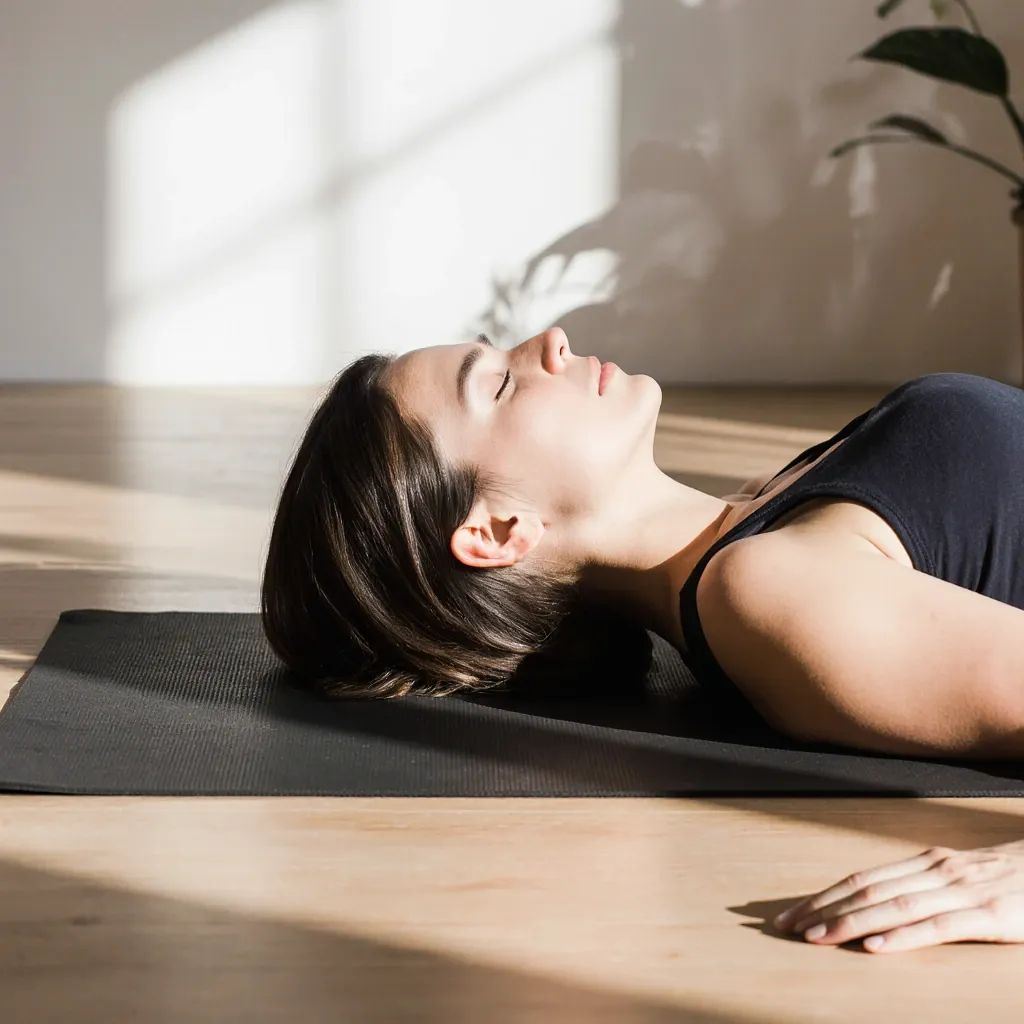
7. Wall or Floor Push
⏱️ Time: 1 minute | 🎯 Best for: dissociation, feeling unreal, physical freeze or shutdown | 💪 Difficulty: Beginner
Press both palms flat against a wall at shoulder height. Push firmly — not to move the wall, but to feel the resistance. Hold for 10 seconds, release, repeat 5–6 times. Or lie on the floor and press your entire back body into the ground — head, shoulders, spine, hips, legs. Feel it holding you completely.
This activates proprioception — your nervous system’s sense of where your body is in space. That signal cuts through dissociation.
⚠️ Common mistake: Doing this passively. You need to actively feel the resistance — bring your full attention to the physical sensation of being pushed back against.
8. Breath Anchor
⏱️ Time: Ongoing | 🎯 Best for: daily maintenance, prevention, between all other techniques | 💪 Difficulty: Beginner
Bring your attention to the sensation of breathing — not controlling the breath, just feeling it. The slight coolness at the nostrils on the inhale. The chest or belly rising and falling. The brief pause between exhale and the next inhale. That pause is your nervous system’s natural rest state.
⚠️ Common mistake: Trying to control or slow the breath immediately. Start by just noticing. Regulation follows awareness — don’t force it.
Which Technique to Use When — Quick Reference

| Situation | Best Technique(s) | Time |
|---|---|---|
| Panic / sudden spike | Cold water → physiological sigh → 5-4-3-2-1 | Under 5 min |
| Overthinking / spiraling | 5-4-3-2-1 sensory method | 3 min |
| Feeling disconnected / unreal | Orienting + wall push | 4 min |
| Background anxiety | Foot-floor + breath anchor | 2–3 min |
| Emotional flooding | Bilateral tapping | 3 min |
| Morning anxiety | Foot-floor + orienting → full morning routine | 5–10 min |
Your 10-Minute Anxiety Reset Plan

The most effective grounding practice isn’t the one you remember in crisis — it’s the one you’ve done so many times when calm that your body reaches for it automatically.
Part 3 of 3 — The Final Section
One last part — wrapping everything up with your action plan and answers to the most common questions.
You're 66% through the full article
🌅 Morning (optional)
2 min — Breath awareness before your phone.
3 min — Foot-floor connection + orienting.
5 min — Slow body scan, head to feet.
⚡ During Anxiety
30 sec — Cold water on wrists or face.
90 sec — Physiological sigh × 5.
3 min — 5-4-3-2-1 sensory method.
🌙 Before Sleep
2 min — Bilateral tapping (butterfly hug).
3 min — Extended exhale breathing.
5 min — Body scan with slow exhales.
If you want a complete step-by-step system — not just individual techniques — the 30-Day Somatic Reset walks you through one 15-minute somatic practice per day, designed to progressively rewire your nervous system baseline over 30 days. → Explore the 30-Day Reset
Frequently Asked Questions
Most somatic grounding techniques produce a noticeable physiological shift within 60–90 seconds. Cold water is fastest (30–60 seconds). The 5-4-3-2-1 method takes 3 minutes. Full nervous system reset via a complete routine takes 10 minutes. Speed depends on how activated the nervous system is — the more acute the anxiety, the longer a full reset may take.
They can significantly shorten and reduce intensity, particularly when combined in sequence: cold water first → physiological sigh → 5-4-3-2-1 → extended exhale breathing. Cold water is the most effective first intervention because it triggers the mammalian diving reflex — an immediate, involuntary parasympathetic response that doesn’t require willpower to activate.
Daily — even when you don’t feel anxious. The goal is to build a conditioned nervous system response so the technique is automatic during crisis. Practicing only during anxiety is like trying to learn to swim while drowning. Daily calm-state practice is what makes grounding work when you actually need it.
If grounding feels ineffective, there are usually two reasons. First, the nervous system may be too activated for the technique to penetrate — try cold water first. Second, the nervous system may be stuck in freeze or shutdown (dorsal vagal) rather than fight-or-flight — in this case, movement-based techniques like wall push or TRE shaking are more effective than breath-based ones.
Standard grounding often involves cognitive tasks — naming states and capitals, doing mental math. Somatic grounding works through the body — sensation, proprioception, temperature, breath — directly regulating the nervous system without requiring the thinking mind to cooperate. It’s more effective for moderate-to-severe anxiety precisely because it doesn’t depend on cognitive capacity, which is reduced during high activation.
Your anxiety isn’t random. It’s your nervous system trying to protect you — running an ancient program that kept humans alive for thousands of years. And once you stop fighting your body and start working with it — everything begins to shift. Not through willpower. Not through thinking harder. Through the body. Through sensation. Through the simple, radical act of telling your nervous system: you’re safe now.
Pick one technique. Practice it today when you feel fine. That’s the whole instruction.
📚 References & Scientific Sources
- Porges, S.W. (2011). The Polyvagal Theory: Neurophysiological Foundations of Emotions, Attachment, Communication, and Self-Regulation. W. W. Norton & Company.
- Levine, P.A. (1997). Waking the Tiger: Healing Trauma. North Atlantic Books.
- van der Kolk, B. (2014). The Body Keeps the Score: Brain, Mind, and Body in the Healing of Trauma. Viking.
- Ogden, P., Minton, K., & Pain, C. (2006). Trauma and the Body: A Sensorimotor Approach to Psychotherapy. W. W. Norton & Company.
- Scaer, R. (2014). The Body Bears the Burden: Trauma, Dissociation, and Disease (3rd ed.). Routledge.
- Shapiro, F. (2018). Eye Movement Desensitization and Reprocessing (EMDR) Therapy (3rd ed.). Guilford Press. [Bilateral stimulation basis]
- LeDoux, J.E. (2015). Anxious: Using the Brain to Understand and Treat Fear and Anxiety. Viking. [Amygdala hijack and prefrontal cortex suppression during anxiety]
- Dana, D. (2018). The Polyvagal Theory in Therapy: Engaging the Rhythm of Regulation. W. W. Norton & Company.
⚠️ Medical Disclaimer
This article is provided for educational and informational purposes only and is not a substitute for professional medical advice, diagnosis, or treatment. The somatic exercises and grounding techniques described here are general wellness practices — they are not clinical interventions.
If you are experiencing symptoms of anxiety, panic disorder, trauma, PTSD, or any mental health condition, please consult a licensed mental health professional or physician. Do not delay seeking professional care because of information you have read on this website. If you are in crisis, contact a mental health crisis helpline in your country immediately.